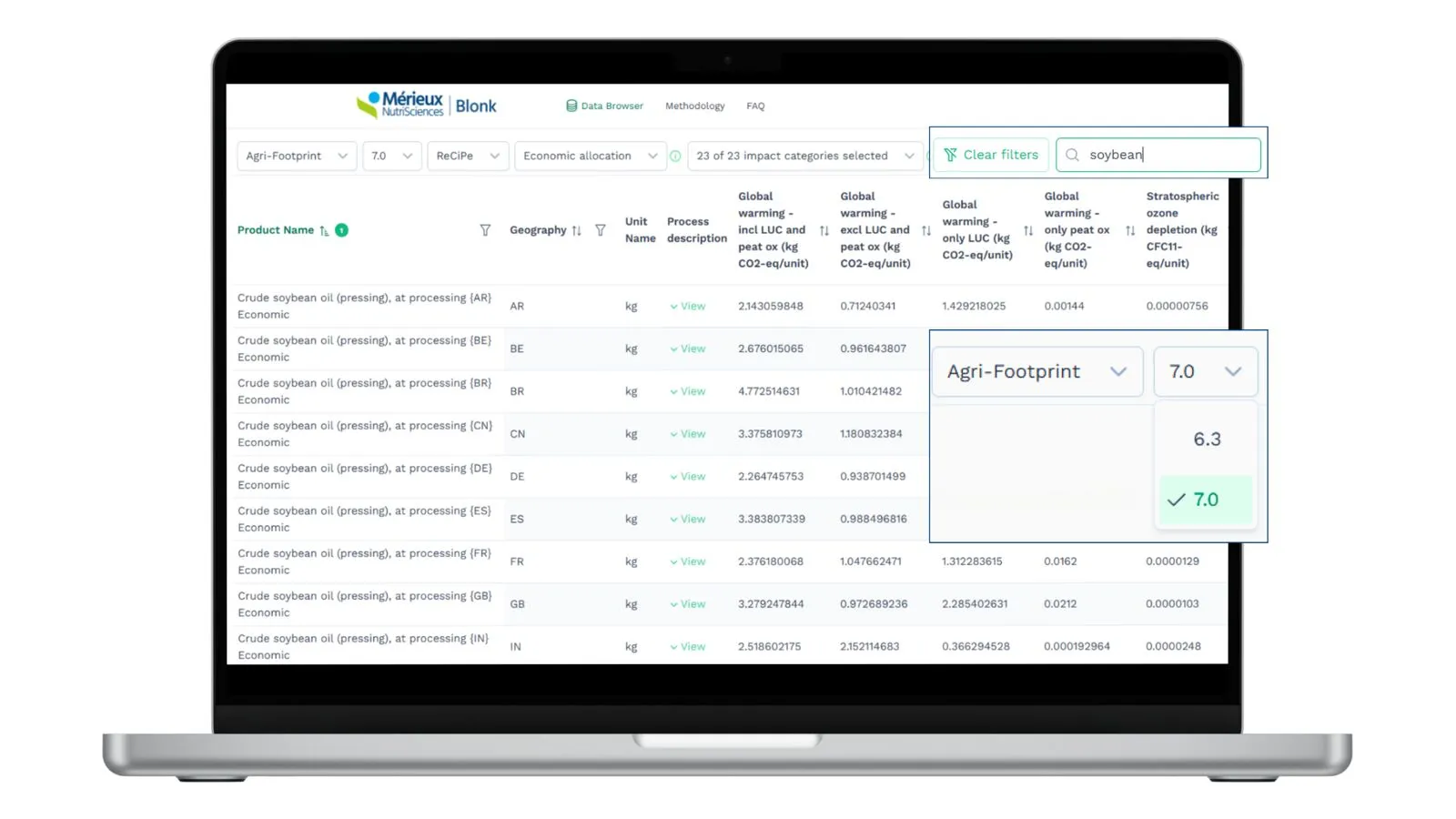
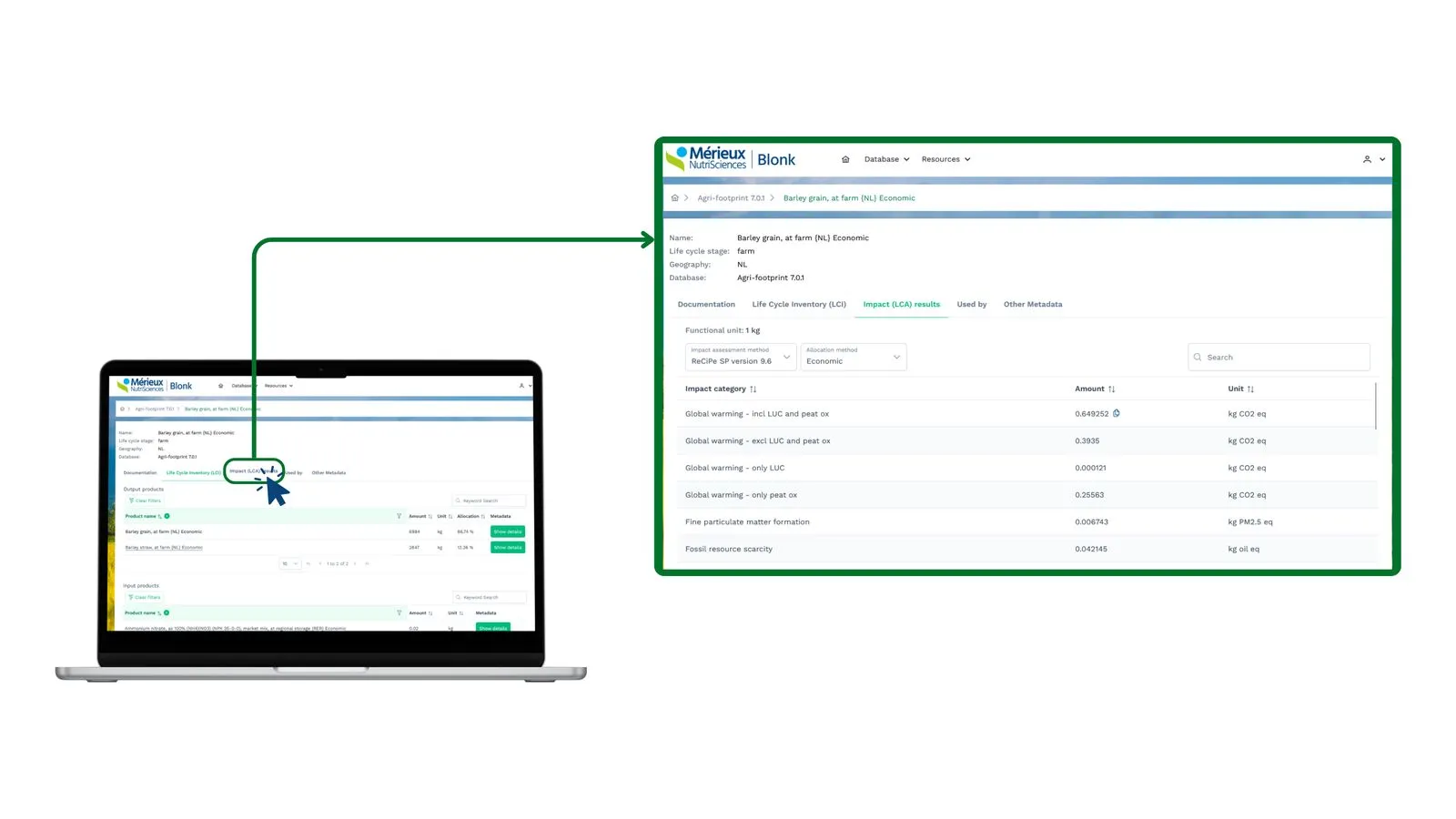
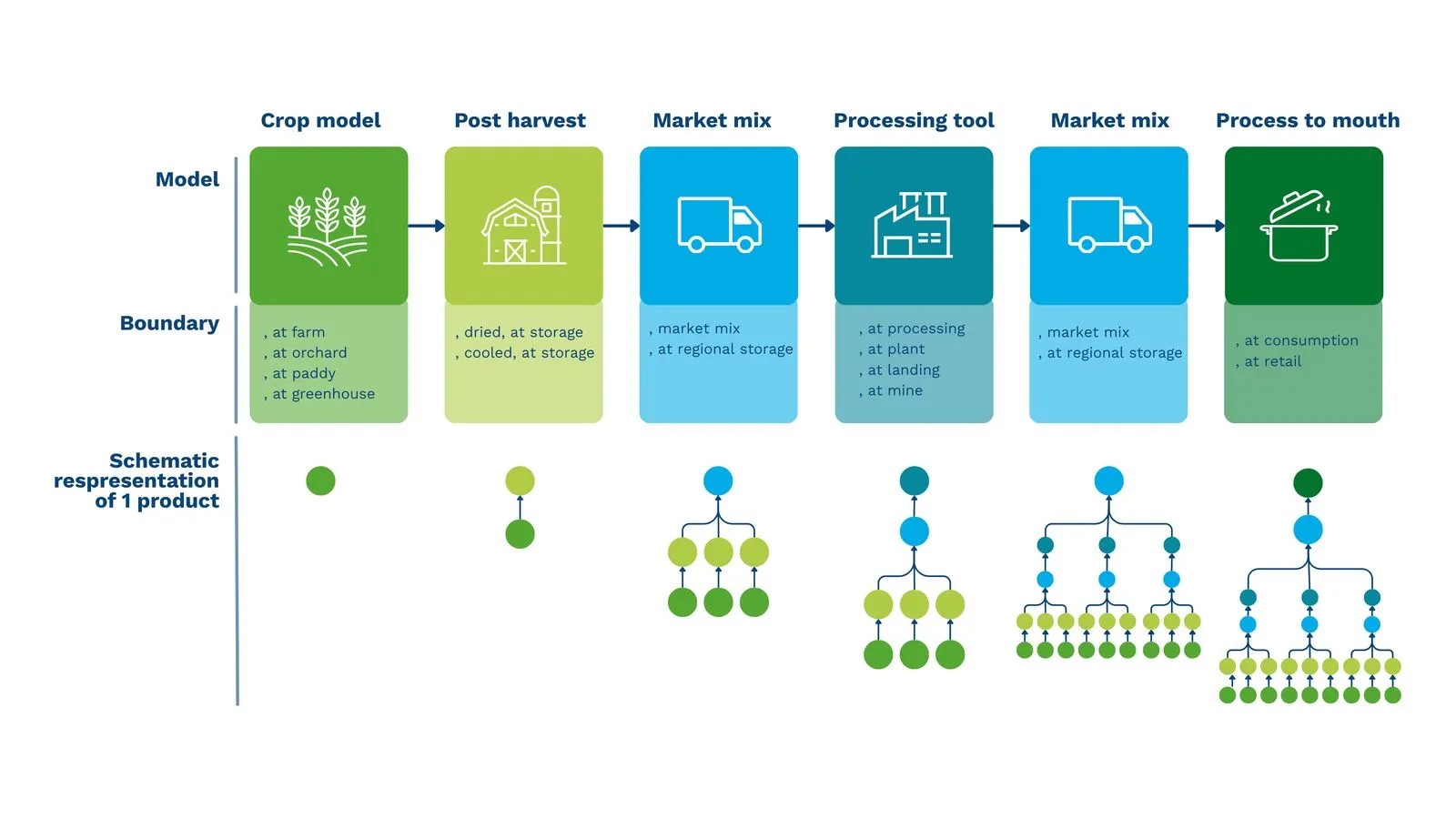
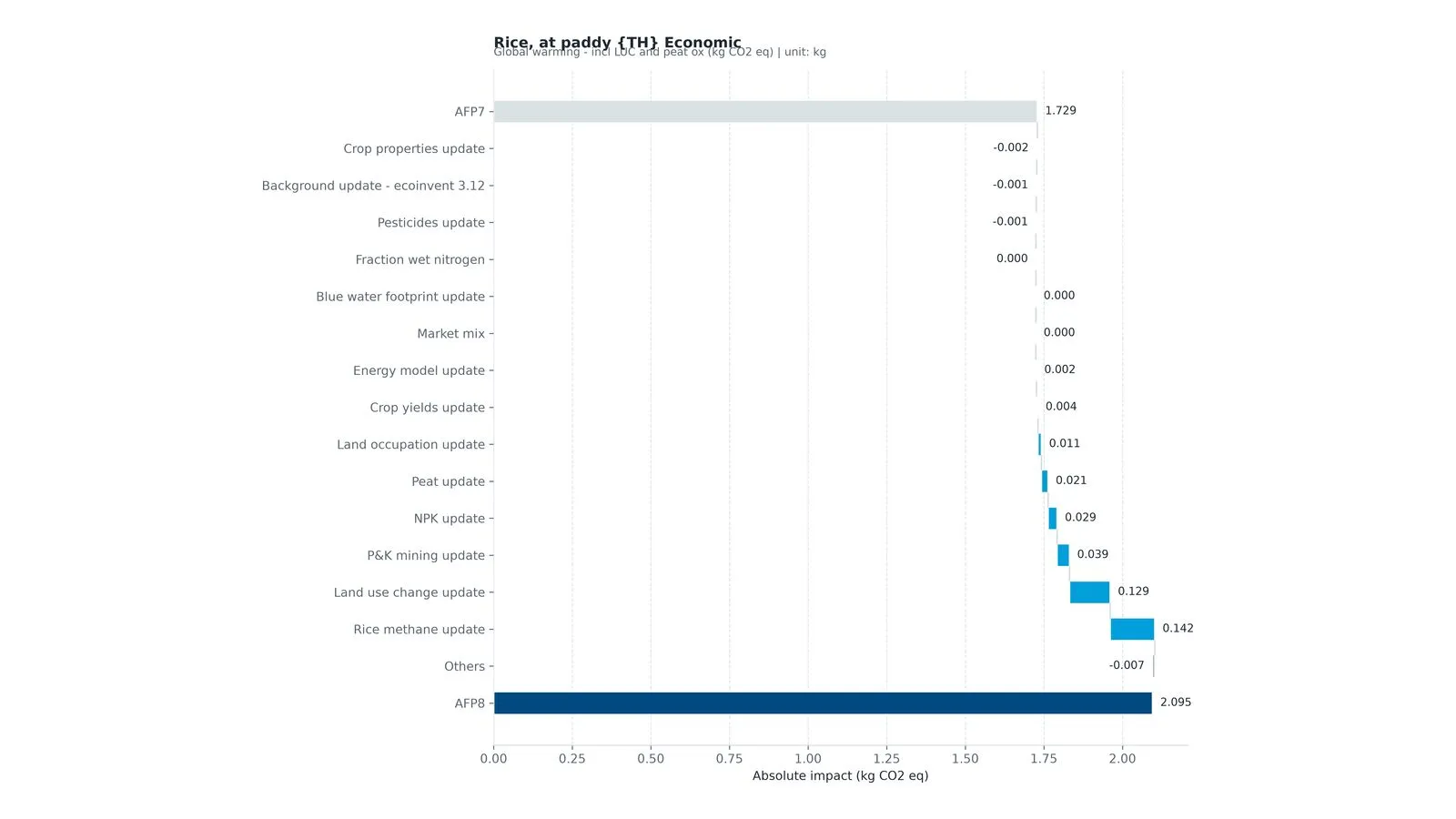
Agri-footprint is the life cycle inventory database for food and agriculture built by Mérieux NutriSciences | Blonk: more than 10,000 datasets on crops, feed, livestock and food products that help food and agri companies calculate credible product footprints and find where their emissions come from.
About Agri-footprint
Agri-footprint is developed by Mérieux NutriSciences | Blonk (Blonk Sustainability), a food system sustainability firm founded in 1999 and headquartered in Rotterdam, with offices in Washington DC and Barcelona. Its team of agri-food and sustainability experts, software engineers and footprint data and methodology specialists draws on more than 20 years of experience in agri-food LCA. Blonk first released Agri-footprint in 2013. Version 8, launched in 2026, doubles the database from 4,800 to more than 10,000 datasets, expands coverage from 74 to 186 geographical regions, updates statistics to a 2019 to 2023 five-year average and adds 2,600+ fruit and vegetable datasets. It is built with Blonk's Data Generation Pipeline, which generates every dataset through code so that results stay consistent, traceable and reproducible. Licensees work in the cloud-based Blonk Data Hub, under Commercial, Developer or Research licences. Beyond the database, Blonk built the European Environmental Footprint of Food database for EFSA with RIVM, and carries out LCAs, footprint methods and tools for clients such as Albert Heijn, Rabobank and Seafish.
They also worked with Agri-footprint
Terrascope
EFSA
Donau Soja
VEOS Group
What Agri-footprint has delivered
TerrascopeCarbon management software
Measuring FLAG emissions in weeks instead of months
Terrascope, a Singapore-based carbon measurement and management platform, could not split land-related emissions for its agri-food customers: existing emission factor databases lacked a breakdown of Forest, Land and Agriculture (FLAG) emissions such as land-use change and land management. Agri-footprint FLAG became the data behind its FLAG module. Terrascope has since helped companies in food, snacks and retail measure their FLAG emissions and set separate targets under the SBTi guidelines. One global food ingredient supplier re-baselined its GHG inventory across dozens of countries, thousands of suppliers and hundreds of facilities in less than 4 weeks.
Building Europe's reference database for the footprint of food
The European Food Safety Authority (EFSA) needed consistent footprint data to compare food products across Europe, where professionals had relied on fragmented sources with different methods. Mérieux NutriSciences | Blonk built the European Environmental Footprint of Food (EFF) database with RIVM, the Dutch National Institute for Public Health and the Environment, using publicly available ELCD and Agri-footprint datasets as background life cycle inventory data. The database follows the EU PEF method, models products from cradle to supermarket and cradle to grave, was critically reviewed by RIVM experts and is open access.
Donau Soja, a non-profit supported by 19 governments and more than 300 members, sets standards for GMO-free soy grown in Europe and wanted buyers to see the environmental performance of certified soybeans. Blonk collected primary data on a defined set of representative farms producing to the Donau Soja / Europe Soya standard: yields, synthetic and organic fertilisers, pesticides, irrigation, fuel use, land occupation and land-use change. The resulting LCA datasets, aligned with Agri-footprint 7, are freely available as CSV files for SimaPro, so feed and food companies can use country-specific soy data and spot hotspots in the chain.
Making plasma and hemoglobin powder footprints public
The European Animal Protein Association (EAPA) represents companies that produce natural animal proteins, including plasma and hemoglobin powders made from blood collected in the meat chain and used in feed. EAPA asked Blonk to align its sector data, previously published in the GFLI database, with Agri-footprint. The datasets model these co-products with mass, economic and energy allocation, and are now publicly available, giving feed manufacturers representative European data for these ingredients.
Up-to-date European data for feed-grade egg powder
VEOS Group turns egg residues from hatcheries, graders and processing plants into feed-grade egg powder. To support transparency across the sector, it asked Blonk to align the European average footprint of this ingredient, previously published in the GFLI database, with the Agri-footprint 7 framework. The inventory was recalculated with Agri-footprint 7.0.1 and ecoinvent 3.11 background data, and the European averages are now open to everyone.
European averages recalculated on current background data
“Using the FLAG module, we have successfully assisted several leading companies in the food, snacks, and retail sectors in swiftly measuring their FLAG emissions and setting separate targets in line with the latest SBTi guidelines”
Felipe Daguila,Chief Customer Officer, Terrascope
“We chose Agri-footprint due to its reputation as a leading agri-food emissions factor database. They offer exceptional granularity, providing detailed breakdowns of emissions across FLAG components, including biogenic and non-biogenic sources within land use change (LUC) and land management (LM) activities.”
One day, real numbers. Meet the companies turning carbon strategy into measurable savings — and benchmark yours against Belgium's sustainability leaders. Seats are limited.
Real ROI case studies — companies saving up to €94k/year
Benchmark your climate strategy against 100+ industry peers
Leave with an actionable, board-ready reduction roadmap