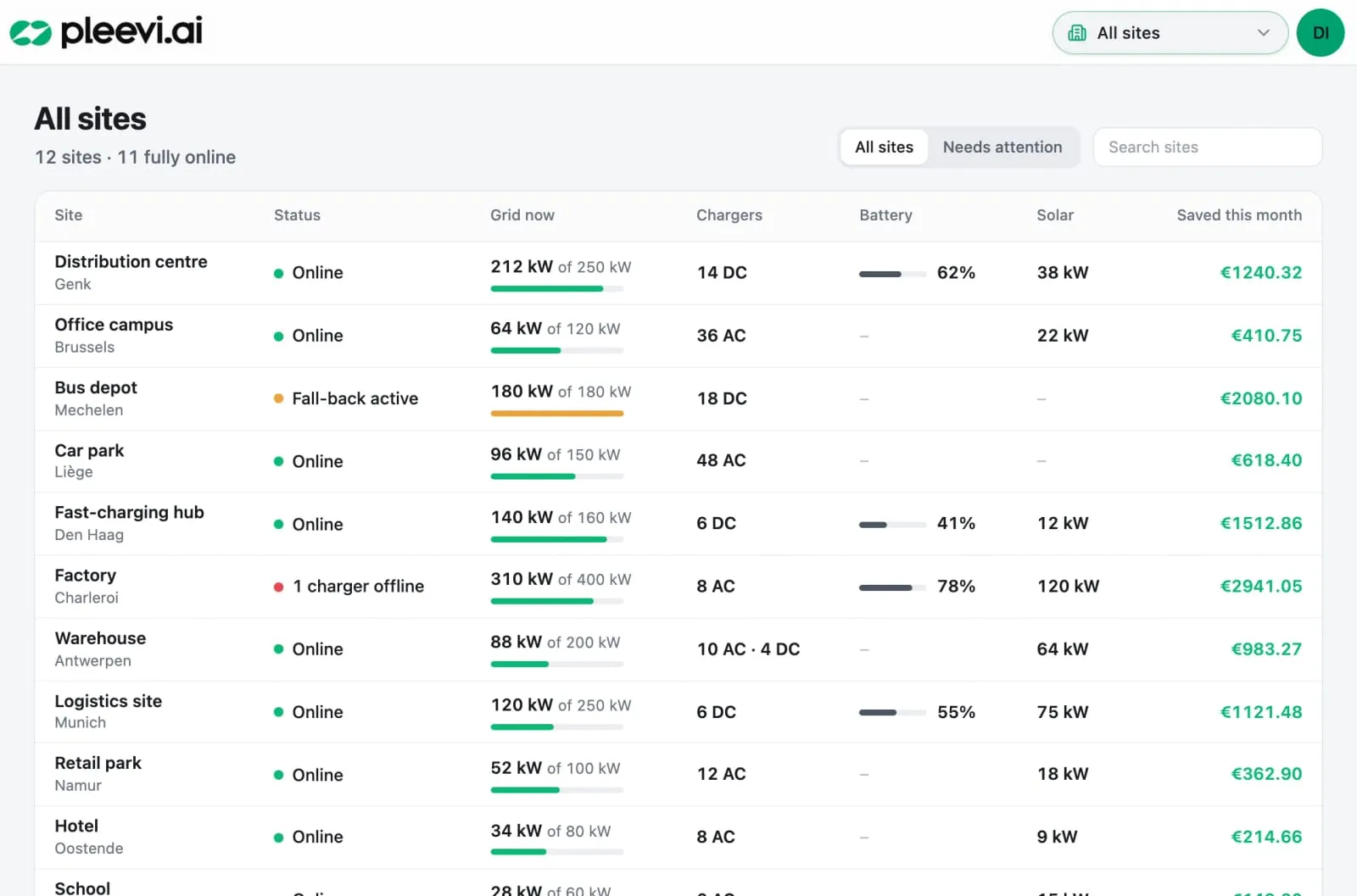
Pleevi is a Brussels energy management system for sites where EV chargers, batteries, solar and the building share one grid connection. It plans every charge ahead around prices, solar output and the grid limit, so a site charges more vehicles at a lower cost without a bigger connection.
About Pleevi
Pleevi was founded in Brussels in late 2024 by Wout Lagae (CEO) and Robin Vanderschueren (CTO). It grew out of more than ten years of energy research at VITO and EnergyVille, where VITO, KU Leuven, imec and UHasselt work together on intelligent energy systems; the optimisation algorithm developed there is the backbone of its products. The platform has four parts: the Pleevi Engine software that plans every asset, the Pleevi Edge controller on site, the Pleevi Studio web platform and a driver app. It serves industry and offices, batteries and energy hubs, fleets and logistics, and public charging and parking, and works with installers, integrators and charge point operators as partners. Teams at Jan De Nul, Fluvius, Soudal, Equans, Atlas Copco, Interparking and Brussels Airport are among those Pleevi lists on its site. Pleevi is backed by Noshaq, Seeder Fund, QBIC Fund, Angelwise and Innoviris, and supported by the EU under InvestEU.
They also worked with Pleevi
Jan De Nul
Fluvius
Soudal
Equans
Atlas Copco
Interparking
Brussels Airport
Aertssen
What Pleevi has delivered
24HNLogistics
Surplus solar charging electric trucks in Stavele
24HN's family-owned logistics site in Stavele has 1 MW of solar and a 700 kWh battery, but its warehouses are used mostly for storage, so it produced far more energy than it used. 24HN put in a fast charger so the trucks that already come to load or take their break can charge at an affordable price. After comparing several energy management systems, it chose Pleevi, which steers every connector on its own so the site's solar and stored energy go into the trucks before grid power. In September 2026, Pleevi Studio's benefit report set the site against load balancing: a monthly peak of 31 kW instead of 268 kW, and drivers got 100% of the energy they asked for. A second 24HN site, with AC charging, now runs on the same platform.
A European hub airport wanted charging across its car parks without waiting years for a bigger grid connection. With 300 kW for 674 charging points, each charger would get less than half a kilowatt if every car plugged in at once, and drivers park and catch their flight without saying when they will be back. Pleevi gives each car park zone its own charging profile (short stays, business trips, long stays), shares the power fairly between groups of cars and redoes the plan every time a car connects or finishes. The car parks have run on Pleevi since 2025, and no driver has to tell the system anything.
Workplace site, 364 AC charge pointsWorkplace charging
364 chargers, 21% lower energy costs
At a workplace with 364 AC charge points, cars stay 6.8 hours on average: 4,234 sessions and 87.7 MWh in one month. With plain load balancing, charging piles up when people arrive and sets the monthly peak. Three strategies were run on the same month of the site's own data: load balancing, Pleevi planning around day-ahead prices, and Pleevi planning around prices and the monthly peak together. Prices alone saved 5.7%; planning the peak as well brought the saving to 21% of the total energy cost, with every car charged to what it needed.
Workplace site, 155 AC charge pointsWorkplace charging with solar
Solar into the cars, 43% off the energy bill
A workplace with 155 AC charge points and its own solar: 3,095 sessions and 103.7 MWh in one month, with cars parked 7.2 hours on average. Load balancing exported the midday solar surplus at low prices and charged the cars from the grid at other times. Pleevi plans every session around the solar forecast, day-ahead prices and the monthly peak. On the same month, the energy cost was 31% lower, the grid peak cost 58% lower and the total cost 43% lower. Injection and offtake each fell by 32 MWh, because more of the site's own solar went into the cars, and every car still got the energy it needed.
Public fast-charging hub, 10 DC chargersPublic fast charging
A battery that takes the hub's peaks
A public hub with ten DC fast chargers on a 1,000 kVA connection and no solar. Drivers charge when they arrive and want to leave quickly, so every busy moment becomes a peak, and the sessions themselves cannot be moved. Pleevi steers a battery instead: it charges in the cheapest quarter-hours of the day-ahead market and discharges into the charging peaks. On a year of the hub's data, two battery sizes were compared with the same hub without a battery. A 600 kWh battery brings the peak from 677 kW to 396 kW and pays for itself in 3.2 years; a 900 kWh battery brings it to 249 kW with a 4.1-year payback, leaving the most room for more chargers.
At a company fleet site, electric company cars charge on AC chargers on the same grid connection as the building's heating and cooling, lighting and processes, and its solar panels. Charging has to fit around a building load that changes through the day and solar that comes and goes, without leaving a driver short. Pleevi forecasts the building's consumption and the solar production and plans the charging quarter-hour by quarter-hour around them; it configured the site and has run it since 2025, with alerts and a monthly benefit report in Pleevi Studio. In Q3 2026, that report set the site against load balancing: an 18.5% lower grid energy cost, and 100% of the energy drivers asked for.
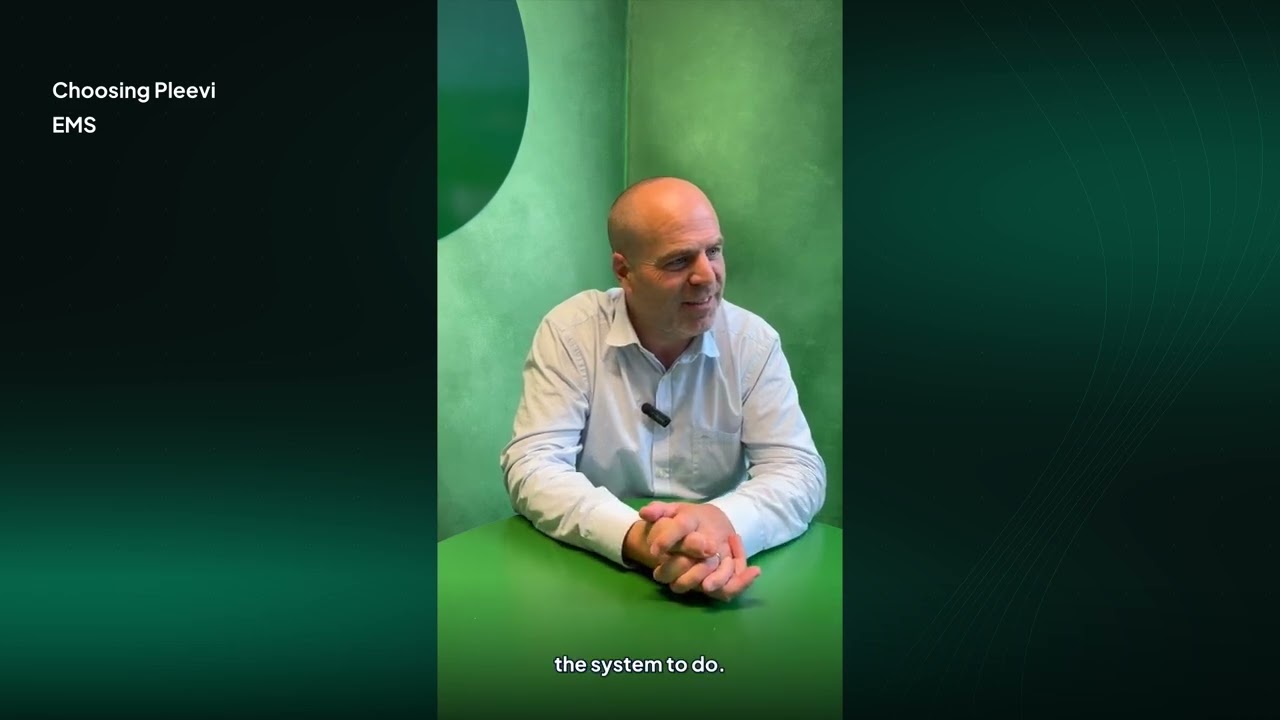
“We looked at a number of EMS systems, and in the end Pleevi’s really came out as the best. And we now see in practice that it really does what we want it to do.”
Bart Lamaire,24HN
“As an electric car driver, Pleevi gives me the peace of mind that my car will be fully charged whenever I need to head out, and in the most eco-friendly way possible.”
Bert Uytterhaegen,Team Lead Engineering, AAtechnics
“Our collaboration with Pleevi enables us to offer clients advanced EV charging solutions that are both efficient and sustainable.”
“Pleevi provides us with a reliable solution for our complex sites with robust power profiles, combining all of our charging possible rules into their flexible powerful engine.”
Frederik Leempoels,Phoenix Contact, MINT EMS platform (platform partner)
One day, real numbers. Meet the companies turning carbon strategy into measurable savings — and benchmark yours against Belgium's sustainability leaders. Seats are limited.
Real ROI case studies — companies saving up to €94k/year
Benchmark your climate strategy against 100+ industry peers
Leave with an actionable, board-ready reduction roadmap