
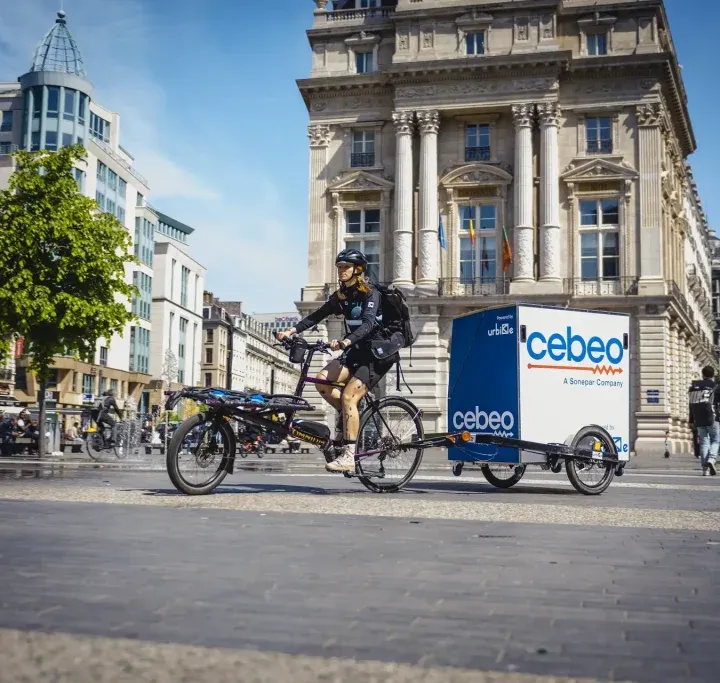
Tapio's platform is intuitive and dynamic — it gives us a clear view of the results and confirms what we already believed: a kilometre by cargo bike has a tiny footprint compared to a motor vehicle. That vision motivates us more than ever in our mission.
urbike × hub.brussels × Tapio: join the peloton of the climate transition
Starting point
Founded in 2018, the Brussels-based cyclo-logistics cooperative urbike offers an ecological and economical solution for the last mile of goods deliveries in the city. A very welcome service in these times of energy crisis, when a kilometre by electric cargo bike is almost 11 times cheaper than a kilometre by electric van. The cooperative’s raison d’être is to transform urban mobility to make Brussels a more sustainable, more human and a better city to live in.
To achieve this goal, the cooperative can count on some forty couriers and a fleet of some forty electric cargo bikes and numerous bicycle trailer solutions. In 2022, the staff travelled 160,000 km to deliver almost 250,000 parcels in Brussels and Ghent. In addition to its operational activities, urbike is working behind the scenes to accelerate the transition by supporting companies and cities with training and consultancy.
By 2026, the cooperative aims to quadruple the volume of deliveries to Brussels. It also plans to triple the number of employees from 40 to 120, the majority of whom will be permanent employees, and to encourage more partners to join the peloton.
The decarbonisation coaching adventure
Initially, urbike wanted to understand and quantify its main sources of emissions in order to know where to act. In 2022, the company was selected with five other startups to participate in a decarbonisation coaching led by June Van Veer, sustainable business model advisor at hub.brussels, and Tapio’s employees.
This support has already enabled urbike to implement several actions to reduce its impact. To reduce its heating consumption, the company decided to lower the temperature of its warehouse and install a thermal curtain at the entrance. The installation of decentralised lighting in the offices and the reminder of good habits (switching off all devices on standby and/or not in use) are also part of the solutions taken from the coaching.
Results analysis
The high level of commitment shown by the urbike representative during the coaching process resulted in a very comprehensive carbon report. The majority of the cooperative’s report is made up of emissions associated with logistics and energy consumption.
In urbike’s case, Scope 3 emissions represent 93.8% of its balance sheet. They are followed by Scope 2 emissions (6.2%), which include emissions linked to the electricity needed for the offices and to recharge their bikes. The cooperative does not generate any emissions associated with Scope 1.
The logistics driver is the most important one with 41.4%. However, this driver does not only include the emissions generated by the electric bike deliveries made by urbike — these represent only 128 kgCO₂e, or 0.3% of the total. In reality, the vast majority of the emissions linked to logistics come from the transport of goods by customers, upstream of the “last miles” carried out by urbike. In other words, customers supply their goods by truck and van, while urbike only intervenes at the end of the chain to make the last mile deliveries by bike.
Energy consumption (heating and electricity for the premises) is in second place with 31.2%, followed by fixed assets (15.1%) representing emissions related to the production of electric bicycles, equipment, IT and furniture.
Solutions
1. Logistics and upstream transport
The main area of reduction concerns the emissions associated with upstream transport. Several solutions can be taken:
- Optimise trailer and container deliveries with “forward buying” — having as many goods as possible arriving at once rather than being transported piecemeal, allowing maximum use of warehouse capacity.
- Encourage suppliers to opt for greener modes of transport (e.g. electric), even if this means translating this into contractual clauses.
2. Energy consumption
In order to reduce its energy consumption, urbike intends to:
- Switch to green electricity.
- Replace the light tubes (which account for 80% of the electricity bill) with LED lamps.
- In the long term, produce its own electricity using photovoltaic panels on the roof and façade.
- Insulate the buildings and improve the heating system efficiency.
A dynamic and intuitive platform
The cooperative’s experience on Tapio’s platform has been positive. The intuitive and dynamic nature of the platform was particularly appreciated, as was its ability to provide a clear view of the results. This vision confirms the small footprint generated by a kilometre travelled by cargo bike compared to a kilometre travelled by motor vehicle — a result that motivates the company more than ever in its mission to accelerate the transition towards sustainable urban logistics.
Want results like this for your team?
Book a 30-minute demo and see how Tapio could turn your carbon data into business decisions.