
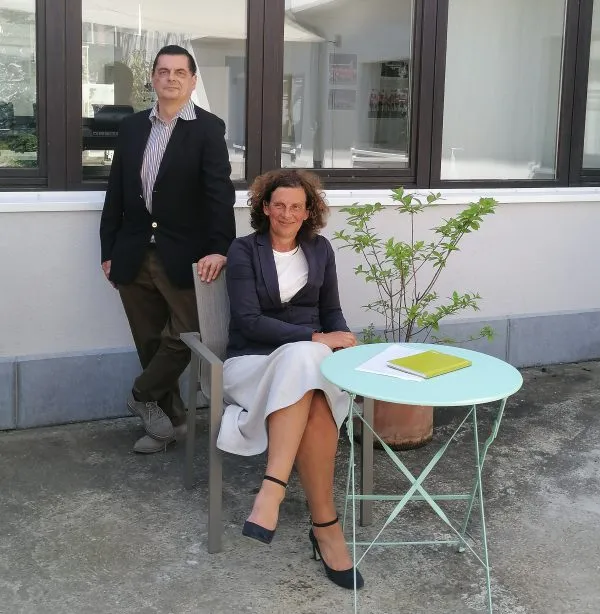
We don't want growth at any price. We want to be sustainable. We want a company that meets society's challenges — and that means putting a carbon budget alongside the financial budget, from day one of every project.
Wavre Hockey Stadium: how Socatra builds for tomorrow
Why tackle the emissions of the construction sector?
The construction sector is fundamental when it comes to fighting climate change. After all, it represents 36% of global greenhouse gas emissions. As Hadrien Cruyt, sustainable construction consultant at SuReal puts it: “At the moment, we are still nowhere near our Paris Agreement commitments, which can be seen as a pact between ourselves and all future generations.”
Luckily, construction companies have the tools to change this situation. Designers, architects, entrepreneurs and material suppliers are increasingly committed to transforming the entire value chain.
Socatra, a three-generation family-owned business based in Brussels, has taken up this challenge by integrating sustainability into the genesis of a mega-building project.
“We don’t want growth at any price. We want to be sustainable. We want a company that is sustainable, and therefore meets society’s challenges.”
— Claudia De Cesco, CEO at Socatra
This is the vision of a three-generation family business — a vision that was immediately put into practice.
The starting point
In 2024, Socatra carried out the carbon report for one of its major projects: constructing the Wavre field hockey stadium for the 2026 World Cup.
This is not Socatra’s only act in favour of the climate. It has installed solar panels, explored alternatives for decarbonized mobility (electric cars for new employees, bicycle parking, car-sharing programs), and when it came to constructing the Wavre stadium, reducing the impact of the building site was part of the plan from the start.
A carbon budget before starting, just like a financial budget
In autumn 2023, the foundation stone was laid for the Wavre field hockey stadium. With a budget of nine million euros and an ambitious timetable, the former soccer stadium will host the World Hockey Championships in 2026. Up to ten thousand spectators can be accommodated. Above all, the stadium has been designed with the future in mind: in case of necessity, it can be used as a storm basin for violent storms.
Site management is in the hands of Socatra, who approached the project with the same sustainable vision. The project is ambitious and will be built to FIH standards.
Socatra and Tapio drew up the carbon report together. This assessment covered all scopes:
- Scope 1 — emissions produced directly by Socatra.
- Scope 2 — indirect emissions linked to the energy consumed by Socatra (heating of offices, vehicle fleet emissions, etc.).
- Scope 3 — emissions linked to the entire value chain, including suppliers.
For scopes 1 and 2, Socatra provided purchase slips and invoices. Tapio processed them through its platform. Socatra accounted for the CO₂e of all its direct purchases of raw materials. The monetary values of purchases from subcontractors were converted into CO₂e emissions according to ADEME standards in the Tapio platform.
How Socatra involves its entire value chain
This carbon report is as ambitious as the project it covers. However, there is still a blind spot, and Socatra is well aware of it: its partners and suppliers are not yet necessarily bound by carbon accounting rules. Their emissions are difficult to account for accurately in Socatra’s balance sheet.
Socatra has therefore set up a solution with Tapio. The construction company started working with its partners by sending them Tapio’s maturity assessment, with the support of Tapio’s team. This tool enables companies to start estimating their carbon emissions and level of maturity when it comes to sustainability.
It’s a first step which, while not intimidating, enables concrete progress to be made.
On a global scale
Hadrien Cruyt points out that legislation varies from country to country, and is not necessarily sufficient to achieve the Paris Agreements. “Today, corporate ambition counts more than ever.”
And more and more companies, like Socatra, are implementing a strategy to meet these necessary but achievable objectives.
“The objectives of the Paris Agreements are achievable. Construction has all the tools it needs. This sector is not condemned to this level of emissions. On the contrary, year after year, by aligning themselves around the unifying objectives of the Paris Agreements, we see successful strategies being implemented, and companies reducing their emissions even further.”
— Hadrien Cruyt, sustainable construction consultant at SuReal
Want results like this for your team?
Book a 30-minute demo and see how Tapio could turn your carbon data into business decisions.