
"We don't wait until it becomes mandatory": Beddeleem already opts for the CO2 Performance Ladder
Beddeleem invests proactively in sustainability and is now adding the CO2 Performance Ladder to its strategy. Sustainability Officer Anne De Coninck explains why the company isn't waiting for certification to become mandatory — and how the Tapio platform helps.

Noa Lambert
Content Marketeer
Beddeleem invests proactively in sustainability management systems. Since 2020, the construction company has been working on CO2 reduction through CO2Logic’s Taking Climate Action label. Now it is adding the CO2 Performance Ladder to its strategy, supported by the Tapio platform.
The CO2 Performance Ladder as a management system
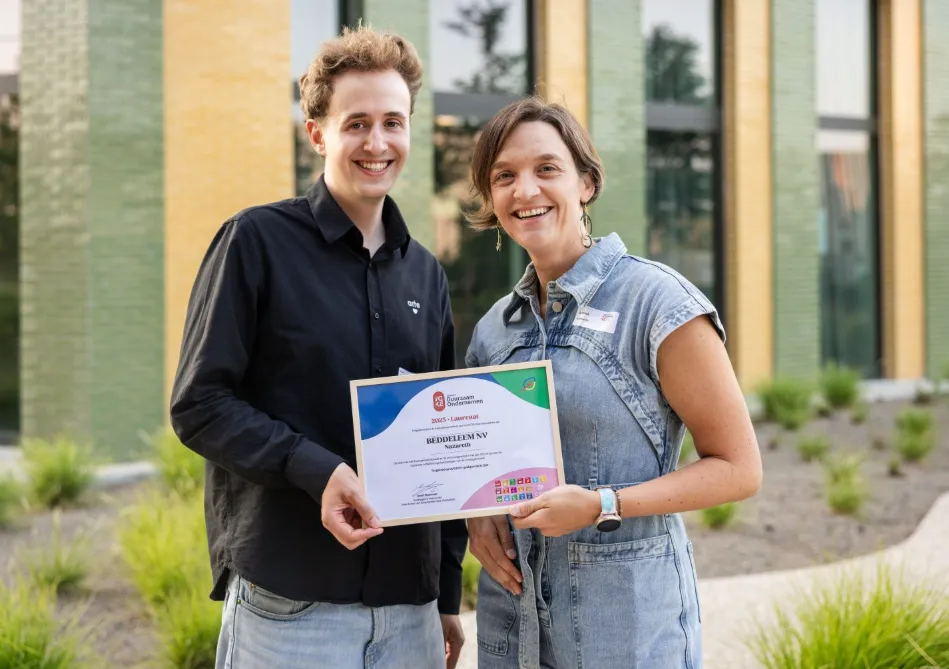 In 2025, Beddeleem received the Voka Charter for Sustainable Enterprise for the fourth year in a row (source: Beddeleem)
Anne De Coninck notes that this certification still rarely appears in tenders, but: “We’re convinced that demand for it will come.”
The company initially chose not to join the pilot phase of the CO2 Performance Ladder because it had already built a solid framework. “We wanted to do it well and not everything at once,” Anne says. “With the label we already had structure, internal buy-in and a clear commitment. Today the CO2 Performance Ladder is added on top, as an extra framework to organise sustainability even better as a management system.”
“We don’t wait until it becomes mandatory. By the time it does, we want to be ready.”
The added value, according to Anne, lies in management involvement: “The fact that the CO2 Performance Ladder is also taken up at management level makes a big difference. That way sustainability doesn’t remain a standalone initiative, but becomes part of how you run your organisation.”
Beddeleem is also seeing growing market momentum around material data and carbon footprints. “We notice more and more questions about material data and CO2. Think of EPDs, LCAs and product carbon footprints. Especially around scope 3, that information is becoming increasingly important.”
Anne does warn, however, that data collection alone is not enough: “You can put a lot of time into collecting data, but the real difference comes from making different choices: thoughtful design decisions, comparing products and materials, testing alternatives and improving step by step.”
From own emissions to electrification
Beddeleem has been working on scope 1 and 2 for years. The solar panels, installed since 2011, long covered the company’s entire annual electricity demand. Further electrification reduced that coverage. The company has run an electrification policy for its fleet since 2021 and put a first electric truck into service in November 2025. A few vehicles run on HVO, while gas consumption is being further optimised.
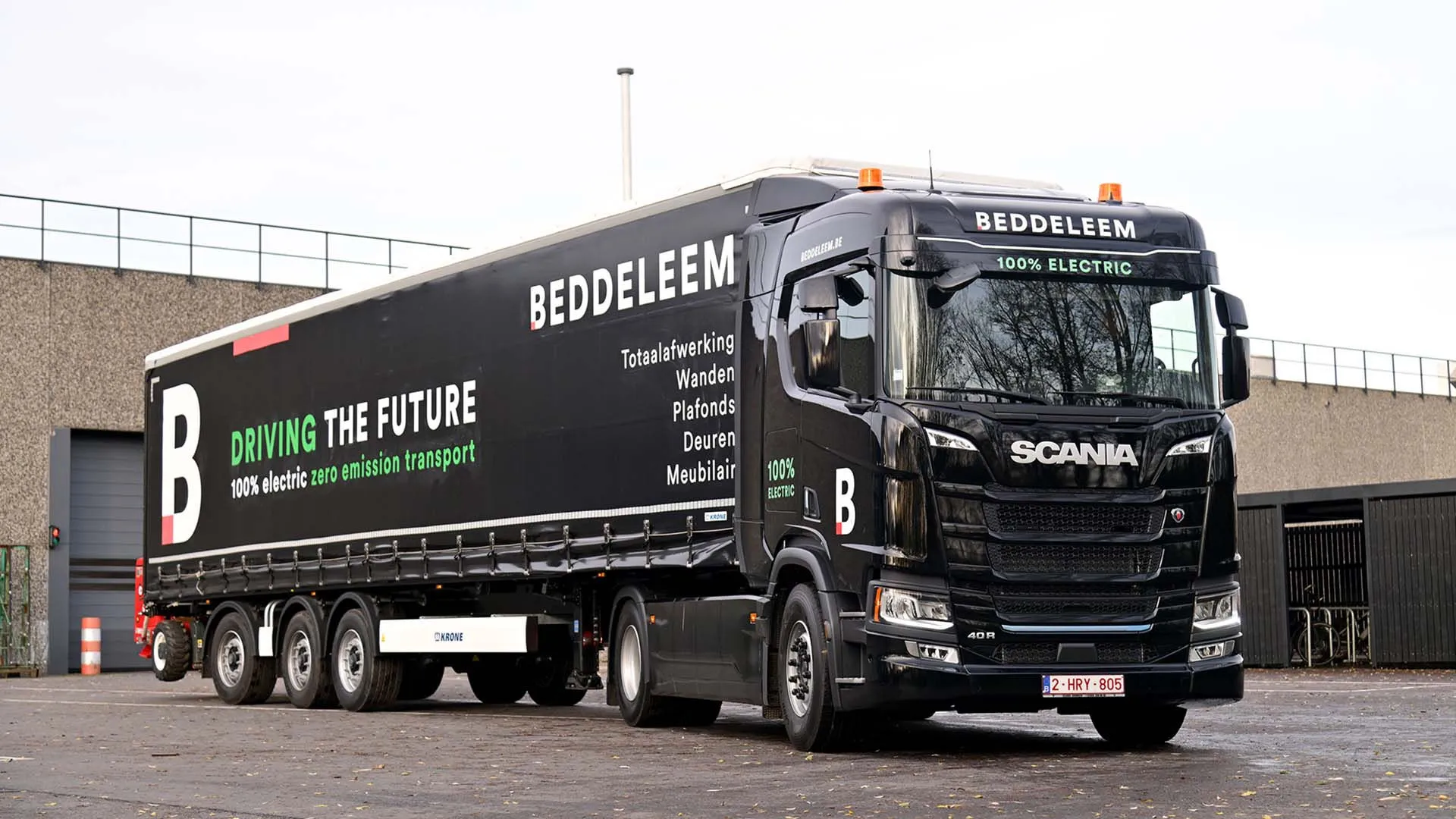 Beddeleem recently acquired its first electric truck (source: Scania.com)
Scope 3 is the biggest challenge. “That’s hard in our sector: you often follow a design and a set of specifications, and by then the materials are already fixed. Construction has a major impact. That’s why we focus on awareness and also put the spotlight on our own products.”
Beddeleem builds EPDs for its own products and analyses product variants via Ecochain to identify areas for improvement. The company actively asks suppliers for certificates and product data so it can compare alternatives and advise customers better.
Scope 3 calls for collaboration and well-founded choices
Still, there are limits. Decentralised purchasing and incomplete data availability in ERP systems make a uniform approach difficult. Moreover, not all responsibility lies with Beddeleem: “When materials are specified by the architect, that choice is made elsewhere. So we focus on where we can actually have an impact.”
Internally, this approach is strongly supported: “Our two CEOs really push sustainability forward. That helps us move faster.”
The decision to invest in the CO2 Performance Ladder now, despite limited demand, is deliberate: “We don’t wait until it becomes mandatory. By the time it does, we want to be ready.”
For practical implementation, Beddeleem works with the Tapio platform. Anne appreciates its ease of use, and especially the CO2 reduction module: “Very clear and ideal for tracking actions.” The platform builds on the structures put in place since 2020 through Taking Climate Action. Targets, history and dashboard communication are easily managed — a requirement within the CO2 Performance Ladder.
What is the CO2 Performance Ladder?

The CO2 Performance Ladder is a certification and management system that helps organisations measure, reduce and transparently report their CO2 emissions. Companies are classified into levels depending on their ambition and maturity. The framework combines insight into emissions (scope 1, 2 and 3), reduction targets, measures and communication. In sectors such as construction, it is increasingly used as a common language to make sustainability efforts demonstrable.
Newsletter
Get one carbon insight a month — no spam.
A monthly note from our experts: one regulation update, one reduction lever, one figure that surprised us.
Curious about how Tapio could help your team?
Book a 30-minute demo with one of our carbon experts.