
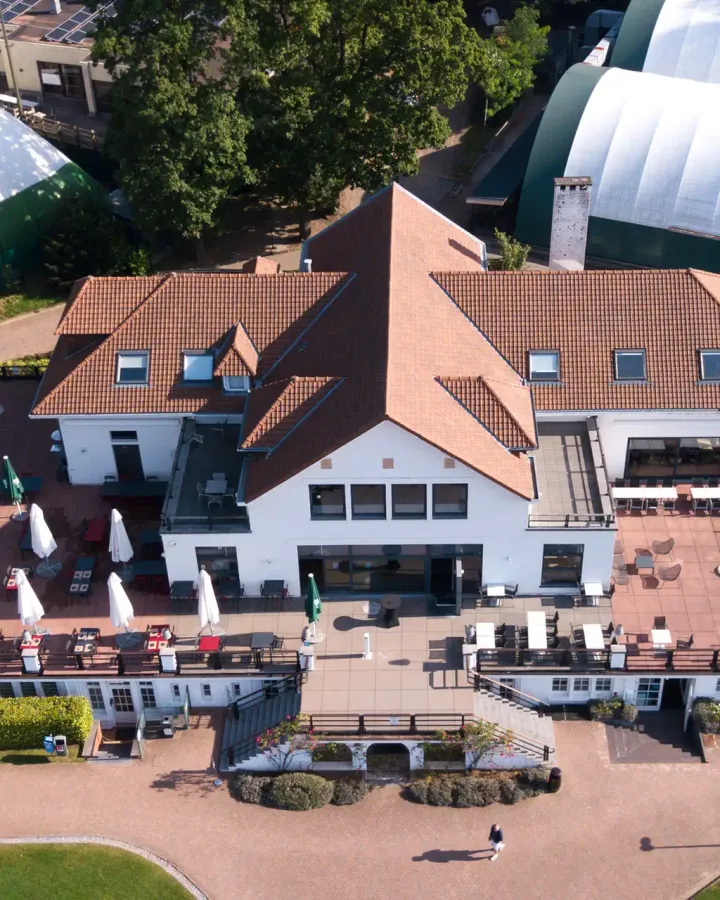
We don't just make young athletes better on the field. We encourage them to become aware of the importance of reducing their carbon footprint — and thanks to Tapio, we now understand where to focus and how to communicate about it.
Royal Léopold Club × Tapio: when love of sports meets climate action
The collaboration between the Royal Léopold Club (aka The Léo or RLC) and Tapio proves that love of sports and climate dynamic can be combined perfectly. Thanks to Tapio, the club now understands its main emission sources.
This will enable its committee to better structure the communication on its actions and onboard all the members and stakeholders more efficiently in its journey towards climate transition.
In a nutshell
- Industry: Sports club (hockey, tennis, squash, padel)
- Number of projects: Carbon report done with Tapio in 2021 (first carbon report with CO2Logic in 2017)
- Location: Brussels
- Carbon Footprint: 1356 tons of CO₂e
- 3000 members, 51 FTE
Starting point
Four years ago, the Royal Léopold Club launched Project21, today known as Leo26. For RLC’s committee, combining sport’s love with a dynamic about climate is essential. As one of the largest sports clubs in the Brussels region (5 hectares and over 3,000 members), the RLC is well aware of the significant impact it could generate among current and younger generations to raise awareness about climate change.
The objectives are twofold:
- Reinforcing the club’s position as a privileged place where families, members and friends meet for their greatest pleasure around sports
- Making the club a reference for sport and leisure clubs in terms of environment and sustainability, and anchoring it in the world of eco-responsibility
Many steps have already been undertaken. The multiplication of awareness campaigns among stakeholders and members, the installation of solar panels, and the organisation of second-hand sales are just a few examples attesting of the club’s willingness to initiate change on its level. The recognition of the RLC as an Eco-Dynamic Organisation — being the first Brussels club receiving its 1st Star from Brussels Environment — demonstrates the club’s commitment to its sustainability ambitions.
However, the big challenge remains how to communicate efficiently on the essential actions to put in place in order to raise awareness among all the members about the importance of its environmental ambitions. To tackle this challenge, a collaboration with Tapio was for the Royal Léopold Club a natural way to go.
Results analysis
Thanks to its expertise, Tapio managed to give the club an overview of its carbon footprint. To do so, the climate tech scale-up focused on the operational boundary — all activities essential to the club’s good functioning. The club contributed to facilitating Tapio’s work. For example, it sent a questionnaire to all the members that enabled Tapio to determine emissions associated with members’ travel to the club and travel to other clubs for sport events or games.
Emissions linked to the heating and electricity required for all the infrastructures (fields, bubbles, the restaurant…) as well as the logistics covering all products and services purchased for the running of the club, the maintenance, or sports equipment like textiles for players, have also been considered.
Mobility is RLC’s first main emission source and accounts for 58.5%. More specifically, just under half of RLC’s total emissions is associated with members’ combustion car journeys from and to the club. The next two main emission sources are energy consumption (19.3%) covering the electricity and the heating needed for all the facilities, and eventually capital assets (13.5%).
In terms of scopes, the majority of RLC’s emissions fall under Scope 3, which covers indirect emissions, followed by Scope 2, which covers emissions linked to the production of energy, electricity and heating. The Royal Léopold Club is directly responsible for its Scope 1 and Scope 2 emissions. Scope 3 covers emission sources related to the RLC’s activities, but whose emissions do not occur within the organisational perimeter.
Solutions
Being aware of its main emission sources, the RLC is more motivated than ever to find solutions. The use of reusable plastic glasses with a deposit instead of disposable ones, the installation of separate waste bins throughout the clubhouse and solar panels, or the banning of air travel are a few of them.
But as discussed before, most of RLC’s emissions falling in Scope 3 are linked with members’ mobility. In other words, the club’s ability to successfully reduce its carbon footprint depends on the society and members’ mentality changes. Let’s take a look at the reduction targets established for 2023, 2025, and 2030 to reduce mobility and energy consumption-related emissions.
1. Mobility
To drastically reduce its mobility emissions by 2023, the RLC aims at achieving a reduction of members’ combustion vehicles to and from the club of 10%. This figure is expected to reach 30% by 2025 and 50% by 2030. To achieve these targets, the RLC’s committee plans to encourage further soft mobility by particularly emphasising on carpooling for car users. The banning of access to the club and the installation of a motorbike parking area in the “green space” of the car park, and the expansion of the bicycle parking area are also key solutions to concretise these ambitions.
In parallel, the club also strives to increase the use of electric cars and recourse to soft mobility by 5%, which is also expected to increase up to 15% by 2025 and to 25% by 2030 — without necessarily aiming for a 100% electric company’s vehicle fleet. Avoiding plane travel also belongs to 2030 objectives.
2. Energy and heating consumption
As previously mentioned, energy and heating consumption are the second main emission sources for RLC. Just like mobility, the club has several solutions on the table: the reduction of the temperature in the club’s infrastructures (clubhouses, changing rooms, indoor tennis courts…), the installation of LED lights, the replacement of conventional switches or twilight switches with motion detectors or timers where appropriate, and the installation of light switches on all tennis, padel, and hockey courts. This also includes encouraging players to make more use of the four energy-efficient tennis courts or grouping bookings.
Regarding the heating consumption for 2023, the RLC hopes to reach a 20% reduction by lowering the average temperature within the infrastructure by 2°C. The club also hopes to have completed the insulation of the Club House & Squash by 2025, which should enable it to reduce its energy consumption by 50% and concretise its ambitions to use 100% green electricity.
For 2030, the RLC wants to reduce its electricity consumption by 20% and to achieve energy efficiency by notably adding a heat pump within the Club House or avoiding any heating within the sport’s infrastructures (tennis, squash, hockey).
Engagement
With its 5 hectares and 3,000 members, the Royal Léopold Club has a non-negligible impact on the environment (water consumption, energy consumption, mobility, incoming and outgoing flows). The club does not just make young athletes better on the field. It encourages them to become aware of the importance of reducing their carbon footprint and safeguarding the environment. In terms of solutions, a lot has already been done. But for the committee, the club’s awareness is not yet optimal and not all members feel sufficiently concerned. To guarantee better awareness among all the club’s members and employees, better structure and communication on the actions is essential.
That’s where the collaboration with Tapio is crucial. Thanks to Tapio’s expertise, the RLC now understands its carbon footprint and is empowered to better structure and communicate on its actions. This should help it to raise awareness more efficiently among all its members and eventually enable it to continue inspiring change on its level.
Just like the Royal Léopold Club, any sports club or organisation can initiate change on its level.
Want results like this for your team?
Book a 30-minute demo and see how Tapio could turn your carbon data into business decisions.