How carbon data enabled Maison Clothes to improve its Ecovadis score by 10% and paved the way for B Corp certification
Reading time: 5 minutes
Reading time: 5 minutes
Company: Maisons Clothes
Sector: Customised textiles and branded merchandise
Location: Belgium and Europe
Description: Maisons Clothes is a retailer of customised products (sweatshirts, caps, tote bags, branded accessories). The company sources its products from external suppliers.

Maisons Clothes already had an EcoVadis certification and wanted to improve its score. The establishment of a credible baseline for carbon emissions across the company earned them additional points and laid the groundwork for the B Corp certification currently underway.
The problem? The branded products industry relies on a large number of suppliers, making carbon data traceability a challenge. Tracking greenhouse gas emissions across a complex supply chain is no simple task.
With Tapio’s help, they manage to build that report from scratch. Here’s how.

If you’re already EcoVadis-rated, you know the feeling: you’ve done the work, built the policies, answered the questionnaire. But without a carbon report, there’s a ceiling on how far your environmental score can go.
EcoVadis rewards companies that go beyond having a sustainability policy and can demonstrate actual measurement. A credible Scope 1, 2, and 3 carbon report signals to enterprise procurement teams that your sustainability claims hold up under scrutiny.
Without a carbon report, the progression becomes difficult. And with a B Corp certification on the horizon, Maisons Clothes knew a proper carbon assessment couldn’t wait.
‘The branded products industry model makes carbon accounting more complex. You don’t control manufacturing, you have thousands of references, and supplier data quality varies. But with methodological rigor and transparency about where proxies are used, you can build a credible report.’
Marie Gilson, Carbon Expert, Tapio

For Maisons Clothes, this wasn’t just a compliance exercise. Measuring their actual impact was a natural extension of their identity. As a family business, leadership wanted to back their values with evidence, not just intention.
That’s also why they chose to work with Tapio. A third-party carbon report carries a credibility that an internal estimate couldn’t.
Alexia Brochier, Marketing and CSR Manager at Maison Clothes, is coordinating the effort across the company with no existing data structure. The challenges were real:

Collecting product data is no simple task when sourcing from a large and diverse supplier base. Alexia had to work with what existed: supplier records, unit counts, and spend data.
Tapio worked from that reality. Step by step, the team mapped what was available, filled gaps with documented estimates where necessary, and built a complete Scope 1, 2, and 3 report, imperfect in places, but transparent about every assumption.
For Alexia Brochier, the process turned out to be less daunting than it first appeared.

‘At first, I thought: this is impossible, there are too many data points, I’ll never manage it. But actually, with Tapio, it’s very smooth. It even becomes almost natural, everything makes sense and everything is logical. The support is really good, you’re never left on your own.’
Alexia Brochier, Marketing and CSR Manager, Maisons Clothes
Supplier behaviour across the textile sector still has gaps, but things are moving. As ESG expectations grow, data quality and accountability are gradually improving industry-wide. Maisons Clothes’ vision is clear: if enough companies start asking for the same data, fabric weights, material breakdowns, emissions by product, suppliers will have to comply. The plan is to keep asking, systematically and repeatedly, and to bring the sector along on the same journey.
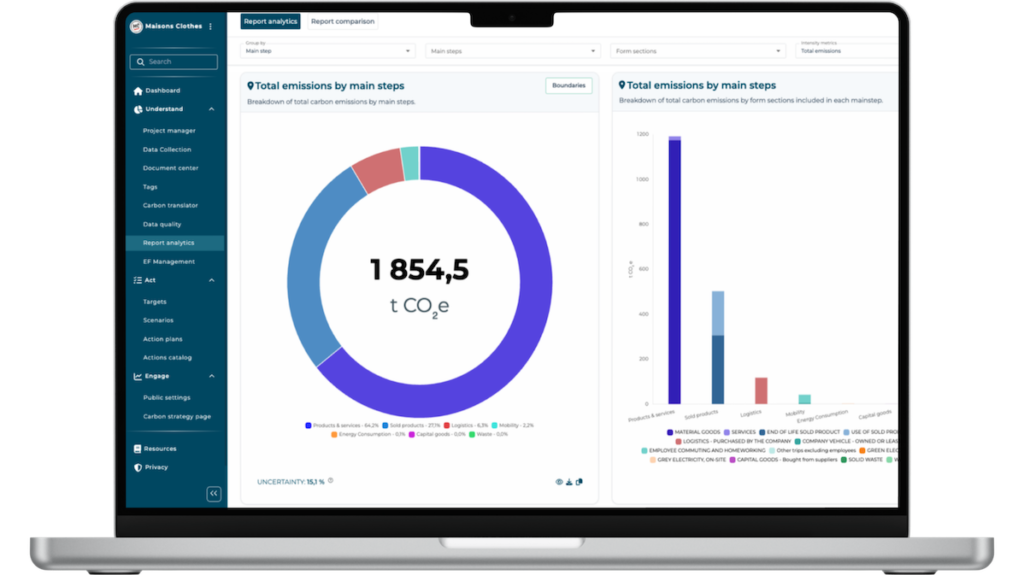
Higher EcoVadis score. Before the carbon report, Maisons Clothes was answering EcoVadis questionnaires without being able to submit emissions data, missing points on every related question. The addition of a comprehensive baseline for scopes 1, 2, and 3 made it possible to answer these questions correctly and raise the score from 80/100 to 88/100.
B Corp certification: the carbon data is ready. B Corp highly recommends carbon data. Maisons Clothes is submitting their application under the new B Corp standards, targeting certification by end 2026 or early 2027. The carbon data puts them in a stronger position to achieve B Corp certification.
Sales support: some customers now include ESG criteria in their procurement process. Having a solid carbon report means being able to answer those questions confidently.
Proof that you’re not cheating. In a market full of sustainability claims, a carbon report based on real, expert-verified data is one of the few things that’s genuinely hard to fabricate. For a company whose identity is built on authenticity, that matters. Not everyone can back it up with numbers verified by a third party like Tapio.
That’s something Maisons Clothes articulates clearly:
‘For us, the carbon report is a necessary step toward our B Corp certification. We wanted transparency and credibility. We’re a family business and we chose to invest in what truly reflects our values. The carbon report let us prove our authenticity.’
Alexia Brochier, Marketing and CSR Manager, Maisons Clothes
A foundation to build on. Looking ahead, Maisons Clothes’ ambition is to refine data quality and engage suppliers and partners as much as possible. The company also wants to improve its scores of its various certifications.

Maisons Clothes didn’t do this to win awards. They did so because it brings significant benefits in terms of finances and competitive positioning. The carbon report is evidence, for certification bodies, for procurement teams and for themselves, that their sustainability commitments are real.
Before measuring their emissions, key certification and customer requests remained unanswered. The carbon report didn’t change what Maisons Clothes sells. It changed what they could prove.
For companies already on the certification path, already EcoVadis-rated, already thinking about B Corp, the carbon report is often the piece that unlocks the next level. You don’t need perfect data to start. You need a credible methodology and a team that knows how to work with what you have and gather the data you’re missing.
If you’re working toward EcoVadis Gold, B Corp, or simply want to know where your emissions actually come from, we’re here to help.