10 years of carbon management: how NGroup turns CO₂ data into savings
Reading time: 5 minutes
Reading time: 5 minutes

Company: NGroup (NRJ, NRJ+, Chérie, Nostalgie, Nostalgie+)
Sector: Media & Broadcasting (radio)
Geography: Belgium
Carbon footprint history: Since 2014 (one of the first media players in Belgium to calculate its CO₂ emissions)

NGroup has been measuring its carbon footprint since 2014. With five radio stations broadcast across Wallonia via FM, DAB+ and digital transmission networks, reducing emissions in a service company is no simple task.
So how do you cut carbon by 25% and generate financial savings when your main source of emissions is the very infrastructure that keeps you on air?
Find out how NGroup and Tapio found a solution in this case study.

NGroup is a Belgian media group operating five radio stations, NRJ, NRJ+, Chérie, Nostalgie and Nostalgie+, through two distinct entities: NRJ (100% owned by the French NRJ Group) and Nostalgie (a joint venture with Belgian media group Mediahuis). NGroup acts as a shared services company, bringing together marketing, communications, finance and CSR functions for the entire group.
NGroup has been measuring its carbon footprint since 2014, making it one of the first Belgian media companies to do so. The initial motivation was clear: as a service company, the group wanted to understand its real environmental impact. What began as an audit exercise gradually became a strategic tool, guiding investment decisions, supplier choices, mobility policy and internal culture.
At NGroup, sustainability doesn’t rest on a single person. Commitment came from the top: the former CEO was a strong advocate of the approach, and the current CEO, Kim Beyns, who has been in post for four years, shares the same values. This continuity of leadership gives Géraldine Deleuse, CSR Director, sustained backing from the executive committee. In practice, when a sustainability issue arises, it quickly reaches the right decision-making level. Over time, this top-down commitment has translated into a cultural shift: in 2023, employees voted to include “Commitment” among the company’s core values, a sign that sustainability had become part of the organisation’s identity.
‘Carbon reporting has, from the start, had the goal of understanding where our real impact lies and taking action. Over the years, that purpose has become an integral part of how we work: our teams, across all departments, think in terms of carbon. And that cultural shift is what makes reductions sustainable.’
Kim Beyns, CEO, NGroup

NGroup had already been measuring its carbon footprint since 2014, but for a long time the exercise could not go beyond data collection. The team gathered figures, produced a report, then moved on. There was no access to data between reports, no Scope 3, and no support for going further.
Moreover, as a broadcaster, NGroup’s primary source of emissions remains its FM transmission network across Wallonia, a cost directly tied to its core business. The shift to digital, which would significantly reduce these emissions, depends on listener adoption and regulatory timelines, factors that are partly beyond NGroup’s control. For a service company, the question was therefore not just about measuring emissions, but about identifying genuinely actionable reduction levers and activating them.
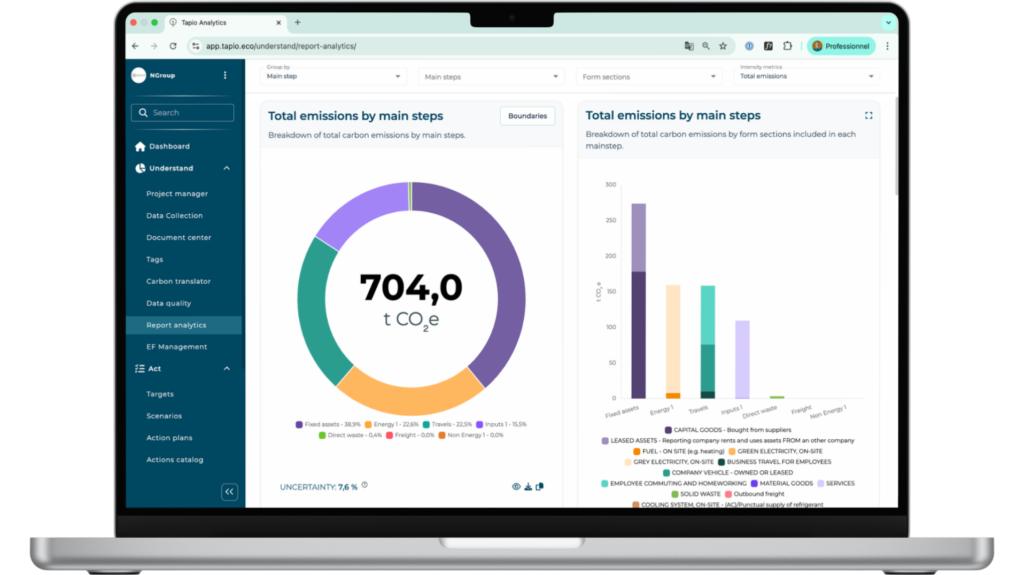
Switching to Tapio five years ago transformed the way the group works. Rather than submitting data and waiting for a result, NGroup gained direct control over the process. A dedicated internal contact manages data entry throughout the year, with the Tapio team on hand to refine methodology, improve data granularity and gradually expand Scope 3 coverage.
What NGroup describes as a co-construction goes beyond the technical dimension. When questions arose about CSRD alignment or how to handle listener device consumption within Scope 3, the team worked through the implications with Tapio. This continuous exchange has transformed the carbon report from an annual compliance exercise into a tool used throughout the year to track progress, compare periods and guide decisions as they arise.
Year after year, Tapio has pushed NGroup to go further: adding Scope 3 categories, strengthening data quality, moving from monetary proxies to physical activity data. The result is carbon reporting that has grown in scope and precision without “inflating” emissions.

‘What sets Tapio apart from what we had before is the expertise and the genuine exchange. The Tapio platform also makes a difference: during the year, we can log in, make year-on-year comparisons and get the data we need immediately. And what’s also very important is that Tapio pushes us to go further. We’ve added Scope 3 elements year after year and have become much more precise. And we’ve expanded the scope without increasing our carbon. For us, that’s extremely motivating.’
Géraldine Deleuse, CSR Director, NGroup
Over a decade of carbon reporting, NGroup has reduced its total emissions by approximately 25%. This was made possible because the carbon report, year after year, highlighted the right levers, and the teams acted on them.
Mobility and building energy were the two largest and most controllable emission categories. The vehicle fleet has been converted almost entirely to electric, with an e-bike leasing scheme introduced for employees not entitled to a company car. Solar panels have been installed on the building, LED lighting has replaced older systems in studios and offices, and water consumption reduction systems have been put in place. A travel policy introduced in 2023 bans flights, both for staff travel and for “prize” trips offered to listeners, which have been replaced with train-accessible destinations.
‘NGroup is an excellent example of what sustained, long-term engagement with carbon data can achieve. Over the years, we have worked together to go beyond the numbers: refining methodology, extending Scope 3 and ensuring that every data point is robust enough to support real decisions. Seeing the emissions curve come down is exactly what this work is for.’
Pascaline du Bus, Lead Carbon Expert, Tapio

The financial case followed the environmental one. Lower fuel costs from the electric fleet and reduced energy bills from building improvements have generated tangible savings, reinforcing the internal argument for continued investment. On the IT side, switching to second-hand server procurement has reduced purchasing-related emissions without compromising operational performance. For companies wondering whether decarbonisation makes economic sense in a services context, NGroup’s experience is clear: the actions that reduce emissions the most are also those that reduce costs.

NGroup’s rigour is also paying off at group level. The NRJ Group consolidates extra-financial data from its subsidiaries for CSRD reporting, and NGroup consistently ranks among the most prepared contributors. Where other entities in other countries are still struggling to gather comparable data, NGroup’s figures are structured, verified and ready.
To learn more about NGroup’s approach, read their activity report or watch the presentation video.